
From Leaving School at 10th to Becoming a Full-Stack Developer: My Complete Journey
I left my studies after 10th because of financial circumstances and started working a full-time job in Surat. Years later, while working 12 hours a day, studying at night, preparing for government exams, and learning technology whenever I could, I eventually found my way into software development. This is the complete story of how I went from a non-technical background to becoming a full-stack developer.

Yash Nandvana
Full Stack Developer
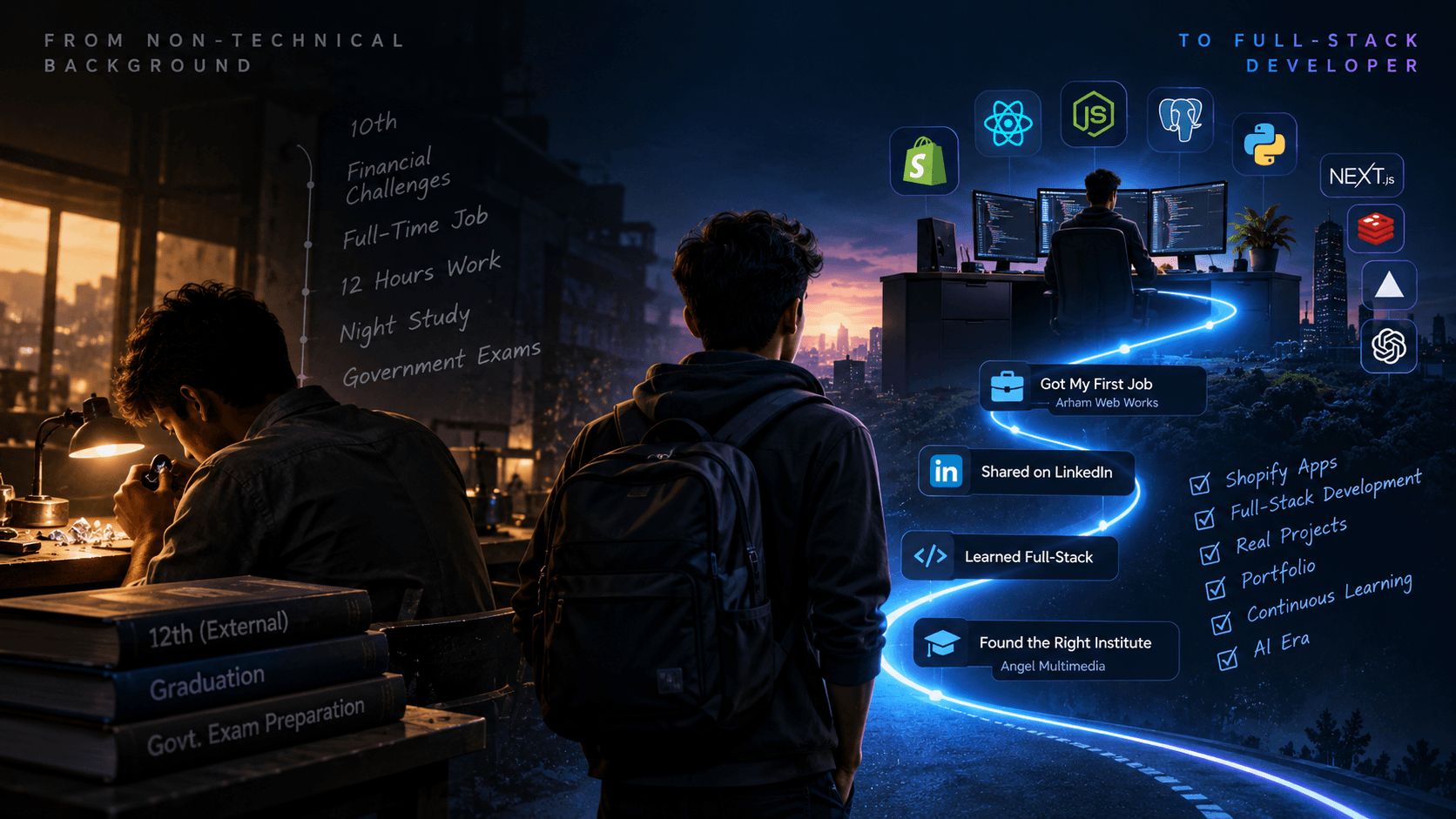
I didn't start my career as a developer.
I didn't study computer science.
I didn't have a laptop with an expensive programming course.
And I definitely didn't have a clear roadmap telling me what I should do.
My journey into technology started from a very different place.
I left my studies after 10th standard because of financial circumstances and started working in Surat.
At that point, I had no idea that years later I would be working professionally in technology, building Shopify apps, working with React and Node.js, building production applications, and continuously learning new technologies.
This is my story.
Leaving Studies After 10th
After completing 10th standard, circumstances forced me to stop my regular education and start working.
I started working in the diamond industry in Surat.
Like many people, I initially thought that this was simply how life would continue.
Work.
Earn.
Support yourself.
Move forward.
But there was always something inside me that didn't feel complete.
I hadn't stopped wanting to learn.
I had simply stopped going to school.
There is an important difference.
Even while working, I knew I wanted to continue my education somehow.
So I made a decision:
I would work during the day and study at night.
It wasn't easy.
My job took around 12 hours every day.
After spending most of the day at work, I had very little energy left.
But I started studying at night anyway.
Two Years of Working and Studying at Night
For almost two years, my routine was basically:
Work → come home → study → sleep → repeat.
There wasn't much free time.
There wasn't a comfortable study schedule.
There wasn't a perfect environment.
But I kept going.
Eventually, I decided to appear for my 12th-standard examination externally.
I passed with 86%.
That result meant much more to me than just a percentage.
It proved something important:
My education had been interrupted, but my learning had not stopped.
After completing 12th, I decided to continue with graduation as well.
At the same time, I was also preparing for government examinations.
At that stage, I thought government jobs were probably the safest career path.
I heard the same thing many people hear:
“Government jobs are secure.”
“Government jobs are better.”
“You should prepare for government exams.”
So I decided to give it a serious attempt.
Working 12 Hours, Studying and Preparing for Government Exams
My routine became even more demanding.
I was working full-time.
I was attending college.
I was studying for government examinations.
And I was trying to manage everything at the same time.
I completed my first year.
Then my second year started.
But eventually, I had to face reality.
Government examination preparation requires serious, focused time.
You cannot treat it like something you casually study for a few hours whenever you have time.
My job already consumed a huge portion of my day.
College required additional time.
And I couldn't give the amount of focused preparation required for government exams.
Trying to do everything meant that I wasn't able to give my best to anything.
That's when I started asking myself a different question:
What do I actually want to do?
I Realized Technology Was Always My Interest
The answer wasn't completely new.
Technology had been interesting to me for years.
I had first started learning about computers around 5th standard.
By the time I reached 10th, I was already quite comfortable with computers compared with what I knew about other areas.
But at that time, technology didn't feel like a realistic career option.
One of the biggest reasons was simple:
Money.
I had heard that technology education could be expensive.
Courses, colleges, computers, training—it all seemed difficult to manage financially.
So I never seriously considered it as my career.
Until I reached a point where I had to make a decision.
I thought:
If I'm going to spend years working and learning anyway, why not spend that effort building something I'm genuinely interested in?
That changed everything.
Choosing Technology
During the middle of my second year of graduation, I made a decision.
I would continue my education.
I would continue working.
But I would also start seriously pursuing technology.
I didn't know exactly how far I could go.
I didn't know whether I could become a professional developer.
I didn't even know whether someone from my background would get an opportunity in the industry.
But I knew one thing:
I wanted to give myself a real chance.
So I started searching for technology courses in Surat.
Finding a Way Into Development
This was another difficult part of the journey.
I searched for institutes and courses.
Some people suggested web design.
Some suggested development.
Some told me technology wasn't for me.
Some questioned whether I was prepared for it.
Some institutes rejected me.
I heard things that made me question myself.
Maybe I wasn't qualified.
Maybe I had started too late.
Maybe I should continue with something safer.
But eventually, I found an institute where I got the opportunity to learn full-stack development:
Angel Multimedia Institute.
That became an important turning point in my life.
Learning Full-Stack Development at Night
My situation still hadn't changed.
I had a full-time job.
I had college.
And now I had a development course.
I didn't suddenly get eight hours every day to learn programming.
I had around two hours at night.
That's it.
So after finishing my work, I would come home and study technology.
Then I would continue my college studies.
Then I would sleep.
And the next day, I would do it again.
For around two years, I gave a huge amount of my available time to learning technology.
Starting With the Fundamentals
I didn't try to skip the basics.
I started with:
I wanted to understand how the pieces fit together.
HTML taught me structure.
CSS taught me how the web is presented.
JavaScript introduced me to programming logic and interactivity.
Then React showed me how modern frontend applications are built.
Node.js opened the backend world.
And gradually, I started understanding that development wasn't just about writing code.
It was about understanding systems.
I Didn't Just Want to Complete a Course
One thing that helped me significantly was that I was genuinely interested in the technology.
I didn't want to simply finish assignments and receive a certificate.
Whenever I learned something, I wanted to understand:
Why does this work?
How does it work internally?
What happens if I change this?
Can I build something with it?
That curiosity made me spend more time learning than I technically needed to.
I became comfortable with learning independently.
And I think that became one of the most important skills of my career.
Discovering LinkedIn
While learning development, I discovered LinkedIn.
I realized something:
There were thousands of developers, engineers, founders and technology professionals sharing what they were learning and building.
So I created my LinkedIn account.
I started sharing my own journey.
I shared:
At first, it wasn't about building a personal brand.
I simply wanted to document my learning.
But something interesting happened.
People started seeing my work.
My network started growing.
And I started understanding the power of showing your work publicly.
My First Opportunity Through LinkedIn
Eventually, LinkedIn became more than a place where I shared posts.
It became a place where opportunities could find me.
I got my opportunity to work in technology through LinkedIn.
I joined Arham Web Works.
That was another major turning point.
Because learning development by yourself is one thing.
Working on real production applications is completely different.
Entering the Real World of Development
When I joined a professional development environment, I realized very quickly that knowing programming languages wasn't enough.
Real development involved:
And I had to learn all of that while actually working.
This was probably one of the fastest periods of growth in my career.
Shopify Changed My Technical Direction
At Arham Web Works, I started working heavily with Shopify.
I learned Shopify theme development.
Then Shopify apps.
Then more advanced Shopify technologies.
My stack started expanding.
I worked with:
I wasn't just building practice projects anymore.
I was working on real products.
From Themes to Shopify Apps
One of the biggest milestones for me was moving beyond theme development and getting deeper into app development.
I worked on Shopify applications and eventually built and managed multiple standalone Shopify apps.
That experience taught me something important:
Building a feature is easy compared with building a feature that has to work reliably for real users.
Production development forces you to think differently.
You start thinking about:
That experience changed the way I approached development.
I Kept Learning Outside of Work
Getting a developer job didn't mean I stopped learning.
Actually, it had the opposite effect.
The more I worked, the more I realized how much I didn't know.
So I continued learning.
I explored:
I also started building my own projects.
Some were experiments.
Some became live projects.
Some taught me what not to do.
And some became things I was genuinely proud of.
Building My Own Portfolio
I also wanted to build a portfolio that represented my actual skills.
Not just:
"I know React."
"I know Node.js."
"I am a full-stack developer."
I wanted the website itself to demonstrate what I could build.
So I built and continuously improved my portfolio.
I experimented with:
My portfolio became another project where I could experiment with technology.
And I still keep improving it.
Two Years Into My Professional Tech Career
Today, I've been working professionally in technology for around two years.
When I look back, the contrast is huge.
I started with a non-technical educational background.
I left regular studies after 10th because of financial circumstances.
I worked in the diamond industry.
I worked long hours.
I studied at night.
I completed 12th externally with 86%.
I continued graduation.
I prepared for government examinations.
I eventually realized that technology was the direction I actually wanted.
I searched for institutes.
I faced rejection.
I found an opportunity to learn full-stack development.
I studied at night while working full-time.
I spent years learning.
I created a LinkedIn presence.
I got my first technology opportunity through LinkedIn.
And now I'm working professionally as a developer.
But I Don't Think the Journey Is Finished
This is probably the most important part of my story.
I don't consider myself someone who has "made it."
I consider myself someone who finally found the direction in which I want to keep growing.
Technology changes incredibly quickly.
New frameworks appear.
New tools appear.
AI is changing how software is built.
Development workflows are changing.
The skills that were valuable yesterday aren't necessarily enough tomorrow.
So I'm still learning.
Learning in the AI Era
Today, AI is probably the biggest shift happening in software development.
And I hear the same concern everywhere:
"AI will replace developers."
I don't know exactly what the future will look like.
But I don't believe the answer is to be afraid of AI.
I believe the answer is to understand it.
Instead of asking:
"Will AI replace me?"
I think developers should ask:
"How can I become the developer who knows how to use AI better than yesterday?"
That's the direction I'm taking.
I'm exploring AI tools, AI development, AI-assisted workflows, agents, automation and the broader changes happening in software engineering.
My Philosophy: Keep Moving With Technology
Technology isn't going to slow down for us.
If a new framework appears, we can ignore it.
If a new tool appears, we can ignore it.
If AI changes development, we can ignore it.
But ignoring change doesn't stop change.
So my approach is different.
I don't believe we need to chase every new technology.
Instead:
Understand the fundamentals.
Build strong engineering skills.
Understand new technologies.
Experiment with them.
Adopt what actually creates value.
Keep moving forward.
That's how I think developers can stay relevant.
What My Journey Taught Me
Looking back, there are several lessons I would give to someone in a situation similar to mine.
1. Your starting point doesn't define your destination
I didn't start with a computer science degree.
I didn't start with a strong financial advantage.
I didn't start with unlimited time.
But none of those things permanently determined where I could go.
2. You may have to learn slower, but you can still move forward
For me, two hours at night was sometimes all I had.
Two hours doesn't sound like much.
But two hours every day becomes hundreds of hours over time.
Consistency compounds.
3. Don't let someone else's opinion become your limitation
I was told technology wasn't necessarily for me.
Some institutes rejected me.
Some people questioned my preparation.
But they were looking at my current situation.
They couldn't see what I was willing to do over the next few years.
4. Real projects teach differently
Courses are useful.
Tutorials are useful.
Documentation is essential.
But eventually, you have to build.
When something breaks in a real application, there is no tutorial telling you exactly what line to change.
You have to investigate.
That's where real engineering starts.
5. Keep sharing what you learn
LinkedIn played an important role in my journey.
Sharing what I was learning helped me:
You don't need to pretend to be an expert.
You can simply document the journey.
6. Don't wait until you feel ready
If I had waited until I felt completely prepared before starting technology, I probably would have started much later.
You rarely feel 100% ready.
Start.
Learn.
Fail.
Improve.
Repeat.
From Two Hours at Night to a Career in Technology
Sometimes I think about how different my life could have been.
If I had accepted that leaving school after 10th meant my education was finished.
If I had decided that a 12-hour job was all I could do.
If I had continued preparing for government exams even when I knew I couldn't give them my best.
If I had listened to every person who told me technology wasn't for me.
If I had never searched for that development course.
If I had stopped learning after getting my first job.
If I had never created a LinkedIn account.
A lot of small decisions had to happen in the right direction.
None of them looked particularly important at the time.
But together, they changed my career.
And I'm Still Learning
Today, I'm still exploring.
I'm learning new technologies.
I'm building projects.
I'm improving my engineering skills.
I'm exploring AI.
I'm thinking about products.
I'm improving my portfolio.
I'm experimenting.
And I'm trying to understand what the next version of a software developer looks like in an AI-first world.
I don't know exactly where this journey will take me.
But I know something now that I didn't know when I left school after 10th:
I can learn.
And once you genuinely believe that, your starting point becomes much less important.
If You're Starting From a Difficult Position
If you're reading this and you're currently in a situation where you think:
"I don't have the right degree."
"I don't have enough money."
"I don't have enough time."
"I'm already late."
"Other people are much ahead of me."
I understand that feeling.
I lived through some version of it.
I'm not saying circumstances don't matter.
They do.
Financial problems are real.
Time constraints are real.
Family responsibilities are real.
Education gaps are real.
But they don't necessarily have to be the end of the story.
Sometimes your path will simply take longer.
That's okay.
You don't need to have the same starting point as everyone else to reach somewhere meaningful.
My Journey Is Still Being Written
From leaving regular studies after 10th...
To working long hours in Surat...
To studying at night...
To completing 12th with 86%...
To continuing graduation...
To preparing for government exams...
To realizing technology was my real interest...
To facing rejection from institutes...
To finding a place where I could learn full-stack development...
To spending two years learning at night...
To discovering LinkedIn...
To getting my first tech opportunity...
To working with Shopify...
To building production Shopify apps...
To becoming a full-stack developer...
To learning Next.js, TypeScript, Python, Redis, BullMQ, DevOps and AI...
And now, continuing to figure out what it means to become a better engineer in the AI era.
This isn't the end of my journey.
It's just the next chapter.
And I'm still learning, still building, and still moving forward.
A note I'd put at the end
If you're coming from a non-technical background and trying to enter technology, don't focus too much on how far you are behind. Focus on what you can learn today.
Your journey doesn't have to look like anyone else's. Mine certainly didn't.
— Yash Nandvana
Yash Nandvana• Full Stack Developer
Full Stack & Shopify Developer building scalable web apps, developer tools, and AI solutions.
Learn more about YashRelated Articles
Shopify Webhooks: A Complete Guide for Developers
A comprehensive, production-tested guide to Shopify webhooks: HMAC signature verification, raw body handling, idempotency with Redis, queue architecture, and local testing.
Shopify GraphQL Admin API: A Practical Guide for Developers
A comprehensive, production-oriented guide to Shopify's GraphQL Admin API: queries, mutations, pagination, rate limit cost calculation, userErrors checking, and bulk operations.
Building a Production-Ready REST API with Node.js, PostgreSQL & Prisma
A comprehensive architectural guide to building production Node.js backends: layer separation, Prisma ORM, PostgreSQL database design, JWT auth, input validation, and security.